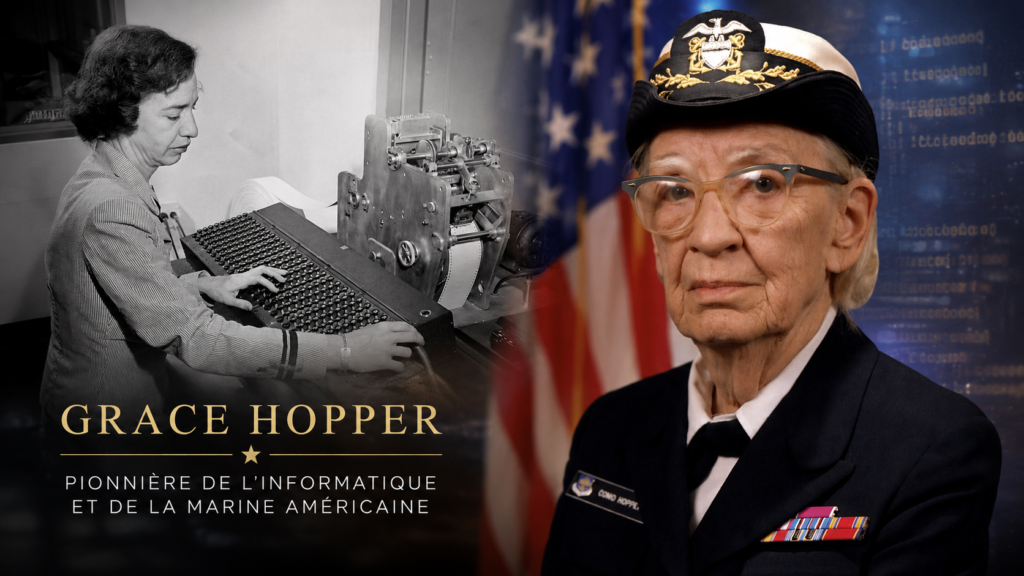
Grace Hopper is one of the most important figures in the history of programming. At a time when computers were massive machines understood by only a small group of specialists, Hopper helped push a radical idea: programming should be easier for humans to understand.
That idea changed software forever.
Today, developers write code using languages that look far more readable than raw machine instructions. Business systems, operating tools, applications, databases, and modern software all depend on the idea that humans should be able to communicate with machines through structured programming languages.
Grace Hopper helped make that future possible.
She was a mathematician, computer scientist, naval officer, teacher, and one of the strongest voices behind the development of human-readable programming. Her work on compilers and COBOL helped move computing from a narrow technical field toward a practical tool for business, government, science, and society.
In the Tech Minds series, Hopper stands as one of the people who made computers not only powerful, but usable.
Who Was Grace Hopper?
Grace Brewster Murray Hopper was born in New York City in 1906. She showed an early interest in mathematics and problem-solving, eventually earning advanced degrees in mathematics before becoming a professor.
During the Second World War, she joined the United States Navy Reserve and became involved in early computing work. She worked with the Harvard Mark I, one of the major early electromechanical computers.
This was an era when computing was still young, difficult, and highly mechanical. Programming was not yet the flexible software discipline we know today. Working with computers required deep knowledge of hardware, numerical procedures, and machine-specific instructions.
Hopper entered this world with a rare combination of mathematical skill, teaching ability, discipline, and imagination. She did not only understand computers. She understood that computers would become more useful if people could communicate with them more naturally.
That belief became the center of her legacy.
The Problem With Early Programming
Early computers were powerful, but they were also difficult to use.
Programmers often had to work close to the machine level. They needed to understand hardware-specific instructions and write commands in ways that were not intuitive for most people. This made programming slow, technical, and limited to a small group of highly trained specialists.
For computing to grow, this had to change.
Businesses, governments, and researchers needed computers to solve real-world problems. But if every program required deep machine-level knowledge, computing would remain too narrow and too expensive.
Grace Hopper understood this clearly. She believed programming should move closer to human language and business logic.
That belief was not obvious at the time. Many people thought computers should be programmed in highly technical ways because that was how machines worked. Hopper pushed against that assumption.
Her vision was simple but powerful:
Computers should adapt to people, not only the other way around.
Grace Hopper and the Compiler
One of Hopper’s most important contributions was her work on compilers.
A compiler is a program that translates human-readable instructions into machine code that a computer can execute. This may sound normal today, but in the early history of computing, it was a major shift.
The compiler changed programming because it created distance between the human programmer and the raw machine.
Instead of writing only low-level instructions, programmers could write in a higher-level language. The compiler would handle the translation into instructions the machine could understand.
This helped make programming faster, more flexible, and more accessible.
Hopper worked on early compiler systems, including the A-0 system. Her work helped prove that machines could translate symbolic instructions into executable code.
This idea became one of the foundations of modern software development.
Every time a developer writes code in a higher-level programming language, they are working in a world Hopper helped create.
COBOL and Business Computing
Grace Hopper is also strongly connected to COBOL, one of the most important programming languages in business history.
COBOL stands for Common Business-Oriented Language. It was designed to be readable, practical, and useful for business data processing. Its syntax was closer to English than many earlier programming methods.
COBOL became widely used in banks, insurance companies, government agencies, payroll systems, and large administrative systems.
The goal was not elegance for academic computer science. The goal was practical computing at scale.
That is what made COBOL important.
Hopper believed that programming languages should be understandable and useful for real organizations. She wanted computing to serve business and administrative needs, not remain locked inside laboratories.
Even decades later, COBOL continued to run important systems around the world. That longevity shows how powerful early business computing decisions became.
Why Grace Hopper’s Ideas Were Revolutionary
Grace Hopper’s ideas were revolutionary because she challenged the culture of early computing.
She argued that programming should become more human-readable. She believed that computers could work with words, symbols, and structured commands instead of only raw numerical instructions.
This mattered because it changed who could participate in computing.
If programming became more understandable, more people could learn it. If more people could learn it, computers could spread into more industries. If computers spread into more industries, software could become a major force in the global economy.
That is exactly what happened.
Modern software development depends on abstraction. Developers rarely work directly with machine code. They use programming languages, frameworks, libraries, APIs, and tools that hide complexity and make systems manageable.
Grace Hopper helped push computing in that direction.
She did not just contribute to one language or one machine. She helped shape the philosophy of software.
The Origin of the “Bug” Story
Grace Hopper is often associated with the popular story of a computer “bug.”
While working with the Harvard Mark II computer, engineers found an actual moth trapped in the machine. The moth was taped into a logbook as the “first actual case of bug being found.”
The word “bug” had been used before in engineering, but this story became one of the most famous anecdotes in computing history.
It is memorable because it captures the early physical reality of computers. These were not invisible cloud systems. They were large machines with relays, wires, moving parts, and physical problems.
The story also became part of Hopper’s public legend. She was known for making technical ideas understandable, memorable, and even humorous.
That communication skill mattered. Hopper did not only build systems. She explained computing to people.
Grace Hopper as a Teacher and Leader
One of the most underrated parts of Grace Hopper’s legacy is her role as a teacher.
She was famous for explaining difficult concepts in simple ways. One of her best-known demonstrations involved using pieces of wire to represent the distance electricity could travel in a nanosecond. This helped people understand why speed and distance mattered in computing.
That kind of explanation is powerful because technology is not only about invention. It is also about communication.
A great technologist helps others understand why an idea matters.
Hopper did this throughout her career. She spoke widely, trained people, challenged assumptions, and encouraged younger generations to think boldly.
Her leadership style combined discipline with curiosity. She became known for encouraging people to try new ideas, question outdated rules, and avoid doing things only because “that is how they have always been done.”
That mindset still feels modern.
Why Grace Hopper Still Matters Today
Grace Hopper still matters because modern programming is built on ideas she helped normalize.
Today’s developers use languages such as Python, JavaScript, Java, C#, Go, Swift, and many others. These languages are different from COBOL, but they share a broader principle: humans should be able to write instructions in structured forms that machines can translate and execute.
That is the world of compilers, interpreters, programming languages, and software abstraction.
Hopper’s influence also appears in the way technology teams think about usability. She understood that systems become more powerful when more people can use them.
This is not only true for programming. It is true for modern AI tools, no-code platforms, cloud dashboards, automation systems, and software interfaces.
The same question remains:
How can we make powerful technology easier for humans to control?
Grace Hopper helped start that conversation in software.
Grace Hopper and Women in Technology
Grace Hopper is also an important figure in the history of women in technology.
Her career challenges the false idea that computing was always a male-dominated field. In the early years of computing, many women played major roles as programmers, mathematicians, operators, and system thinkers.
Hopper became one of the most visible and respected figures among them.
She served in the U.S. Navy, worked in advanced computing, influenced programming language development, and became a public symbol of technical excellence.
Her story matters because representation shapes ambition. When people see someone like Hopper in the history of computing, they understand that software was built by a wider range of minds than many simplified tech histories suggest.
She was not a side character in computing history.
She was one of its architects.
Lessons From Grace Hopper’s Legacy
Grace Hopper’s legacy offers several important lessons for today’s technology world.
The first lesson is that usability matters. A powerful system is limited if people cannot understand or use it effectively.
The second lesson is that abstraction drives progress. Programming became more scalable because developers did not have to work directly with machine instructions all the time.
The third lesson is that communication is part of innovation. Hopper’s ability to explain computing helped spread ideas beyond technical circles.
The fourth lesson is that rules should be questioned. Hopper was known for challenging rigid thinking and pushing people to try better methods.
The fifth lesson is that software is not only about machines. It is about making machines useful for human goals.
These lessons remain relevant in the age of AI, automation, and cloud software.
Grace Hopper in the Age of AI
Grace Hopper’s ideas feel especially relevant today because artificial intelligence is entering a phase similar to early computing.
AI is powerful, but many people still find it difficult to understand, control, or trust. The next major challenge is not only making AI more advanced. It is making AI more usable, explainable, and aligned with human needs.
That is a very Hopper-like problem.
Just as compilers helped people communicate with computers more effectively, modern AI interfaces may help people communicate with complex systems through natural language, visual tools, and automation workflows.
But the deeper principle is the same:
Technology becomes transformative when humans can use it without needing to understand every hidden layer.
Grace Hopper helped prove that idea in programming. The AI era is now testing it again.
Final Thoughts
Grace Hopper helped change the direction of computing by making programming more human.
Her work on compilers, her influence on COBOL, her teaching, and her leadership helped move computers from specialized machines toward practical tools used by organizations and people around the world.
She understood that the future of computing would not be built only by making machines faster. It would also be built by making them easier to command.
That is why Grace Hopper belongs in Encyclotech’s Tech Minds series.
She was not just a programmer or naval officer. She was one of the people who helped turn computing into software.