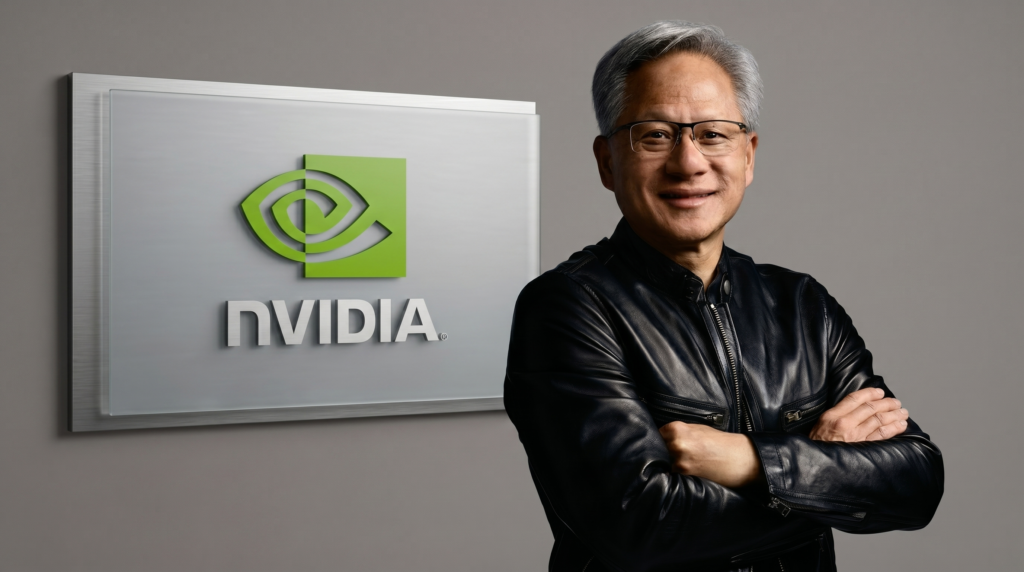
Jensen Huang is one of the most influential technology leaders of the AI era.
For years, NVIDIA was mostly known as a graphics company. Gamers knew it for powerful GPUs. Designers and visual effects artists knew it for rendering. Engineers knew it for high-performance computing. But when artificial intelligence exploded into the mainstream, NVIDIA became something much bigger: the engine room of modern AI.
At the center of that transformation is Jensen Huang, NVIDIA’s co-founder and CEO.
His story is not only about building a successful chip company. It is about seeing that graphics processors could become a new foundation for computing itself. Long before GPUs became the core hardware behind AI training, data centers, robotics, simulations, and scientific computing, Huang pushed NVIDIA toward accelerated computing.
That long-term bet changed the company and helped reshape the technology industry.
In the Tech Minds series, Jensen Huang represents a different kind of innovator: not the inventor of a single programming language, web protocol, or theory, but the leader who helped turn specialized hardware into the infrastructure of the AI age.
Who Is Jensen Huang?
Jensen Huang is the founder, president, and CEO of NVIDIA. He co-founded the company in 1993 with Chris Malachowsky and Curtis Priem, with the original goal of bringing 3D graphics to gaming and multimedia computing.
Before NVIDIA, Huang worked in the semiconductor industry, including roles at AMD and LSI Logic. That background gave him deep exposure to chip design, hardware markets, and the difficult business of building computing platforms.
NVIDIA’s early years were not about artificial intelligence. They were about graphics.
At the time, personal computers were becoming more powerful, but real-time 3D graphics were still difficult. Video games, visual computing, and multimedia needed dedicated hardware that could process images faster than a general-purpose CPU.
That was NVIDIA’s opening.
The company focused on graphics processing units, or GPUs, and helped define a market that would later become much larger than gaming.
From Graphics to the GPU Revolution
The GPU was originally built to solve a graphics problem.
Rendering images, polygons, lighting, textures, and motion requires many calculations at the same time. Unlike a CPU, which is designed for broad general-purpose tasks, a GPU can process many operations in parallel.
That parallel structure made GPUs perfect for graphics.
But it also made them useful for something else: workloads that require massive parallel computation.
This became one of the most important insights in NVIDIA’s history.
A chip designed for graphics could also be used for scientific computing, simulation, machine learning, and eventually deep learning. The same architecture that made games look better could help train AI models.
That is the bridge Jensen Huang helped NVIDIA cross.
He did not keep the company locked inside gaming. He pushed it toward a broader idea: accelerated computing.
What Is Accelerated Computing?
Accelerated computing is the idea that certain workloads should be handled by specialized processors rather than only by traditional CPUs.
A CPU is flexible, but it is not always the most efficient tool for every job. Some problems need large-scale parallel processing. GPUs are strong in that area.
In accelerated computing, the CPU and GPU work together. The CPU manages general tasks, while the GPU accelerates heavy parallel workloads such as graphics rendering, AI training, simulation, scientific modeling, and data processing.
This is now central to modern AI.
Training large AI models requires enormous matrix calculations and repeated operations over massive datasets. GPUs are well suited for that work because they can perform many calculations simultaneously.
That is why NVIDIA became so important to the AI boom.
The company was not simply lucky. It had spent years building hardware, software, developer tools, and an ecosystem around accelerated computing before AI demand reached historic levels.
CUDA: NVIDIA’s Hidden Strategic Weapon
One of NVIDIA’s most important moves was CUDA.
CUDA is NVIDIA’s parallel computing platform and programming model. It allows developers to use NVIDIA GPUs for general-purpose computing, not just graphics.
This mattered because hardware alone is not enough.
A powerful chip becomes much more valuable when developers can program it, optimize it, and build real applications around it. CUDA gave researchers and engineers a way to unlock the GPU for scientific computing, machine learning, simulations, and high-performance workloads.
In the long term, CUDA became a major strategic advantage for NVIDIA.
Competitors could build chips, but NVIDIA had built an ecosystem. Developers learned CUDA. Research labs used CUDA. AI frameworks supported NVIDIA GPUs. Data centers standardized around NVIDIA hardware and software.
That software layer helped turn NVIDIA from a chip supplier into a platform company.
For Jensen Huang, this was one of the defining strategic decisions: NVIDIA would not only sell faster processors. It would build the computing stack around them.
Jensen Huang and the AI Boom
The AI boom changed NVIDIA’s position in the world.
As large language models, generative AI tools, recommendation systems, computer vision models, and autonomous systems grew more demanding, the need for high-performance AI chips exploded.
NVIDIA GPUs became the preferred hardware for many AI workloads.
Companies building advanced AI systems needed massive compute power. Cloud providers, startups, research labs, and enterprise AI teams all needed GPUs to train and run models.
This demand pushed NVIDIA into the center of the global technology economy.
Jensen Huang became one of the most watched CEOs in the world because his company was no longer only serving gamers or graphics professionals. NVIDIA was now supplying the infrastructure behind AI.
When people talk about the AI revolution, they often focus on models and applications. Chatbots, image generators, coding tools, and AI assistants get most of the attention.
But behind those tools are chips, data centers, networking systems, memory, software libraries, and developer platforms.
That is NVIDIA’s world.
Blackwell and the Next AI Infrastructure Layer
NVIDIA’s Blackwell architecture represents the company’s push into the next phase of AI infrastructure.
Blackwell is designed for large-scale AI workloads, including generative AI, data processing, engineering simulation, drug discovery, quantum computing, and other demanding applications. NVIDIA describes Blackwell as a platform built for a new era of computing.
This matters because AI is becoming more compute-hungry.
Training and running advanced AI systems requires more than individual GPUs. It requires entire AI factories: data centers designed specifically to process, train, and serve AI models at scale.
Jensen Huang has often framed AI infrastructure as a new industrial layer. In this view, data centers are not just server rooms. They are factories that transform data and energy into intelligence.
That is a powerful framing because it shows how NVIDIA wants to define the next computing platform.
Just as PCs defined one era and smartphones defined another, AI infrastructure may define the next.
Why Jensen Huang’s Leadership Stands Out
Jensen Huang’s leadership stands out because of his patience and consistency.
NVIDIA spent decades building technologies that became essential later. The company did not become central to AI overnight. It invested in GPUs, CUDA, developer communities, high-performance computing, data center products, and AI software long before mainstream attention arrived.
That is rare.
Many companies chase trends after they become obvious. NVIDIA prepared for a trend before the world fully understood it.
Huang also turned himself into a recognizable public figure. His keynote presentations, leather jacket, technical storytelling, and direct explanations have made him one of the most visible executives in technology.
But the more important point is strategic clarity.
He consistently pushed the idea that accelerated computing would reshape the industry. For many years, that sounded like a specialized hardware story. Today, it looks like one of the most important technology bets of the century.
NVIDIA Beyond AI Chips
NVIDIA is now far more than a GPU company.
Its ecosystem touches several major technology areas:
AI data centers
Gaming graphics
Professional visualization
Autonomous vehicles
Robotics
Digital twins
Healthcare research
Scientific computing
Cloud AI infrastructure
Edge AI devices
This broad reach is important because NVIDIA’s platform strategy is not limited to one market.
The company wants its hardware and software stack to power many forms of accelerated computing. That includes AI models in data centers, simulation tools for factories, robotics systems, autonomous driving platforms, and scientific research workloads.
This is why Jensen Huang’s influence is not limited to the semiconductor industry.
His decisions affect cloud computing, enterprise AI, robotics, software development, gaming, and even national technology strategy.
Criticism and Risks
A serious profile should not treat Jensen Huang’s rise as a simple success story without risks.
NVIDIA faces several challenges.
The first is competition. AMD, Intel, custom AI chip startups, cloud providers, and in-house silicon teams are all trying to reduce dependence on NVIDIA hardware.
The second is supply chain pressure. Advanced AI chips depend on complex manufacturing, packaging, memory, and global semiconductor partnerships.
The third is regulation. AI chips are now strategically important, which means export controls, geopolitical tensions, and national security rules can affect NVIDIA’s business.
The fourth is customer concentration. Some of NVIDIA’s largest buyers are major cloud and AI companies. If those companies build more of their own chips, NVIDIA will need to keep proving its value.
The fifth is market expectations. When a company becomes central to a boom, investors may expect perfection. That creates pressure.
Still, NVIDIA’s advantage is not only its chips. It is the full stack: hardware, software, networking, developer tools, and ecosystem momentum.
That is harder to copy.
Why Jensen Huang Still Matters Today
Jensen Huang matters today because AI is becoming an infrastructure race.
The future of AI will not be decided only by better models. It will also be shaped by who controls the compute layer.
The companies with access to the best AI infrastructure will train stronger models, run more efficient inference, and build faster AI products. This makes GPUs and AI chips strategically important.
Huang helped place NVIDIA at the center of that layer.
His work matters for:
AI model training
AI inference
Cloud infrastructure
Robotics
Scientific discovery
Autonomous systems
Gaming and graphics
Industrial simulation
Future computing platforms
In other words, Jensen Huang helped move the GPU from a graphics tool to a general engine for modern computing.
That is his biggest legacy.
Lessons From Jensen Huang’s Career
Jensen Huang’s career offers several lessons for technology builders.
The first lesson is that platforms beat products. NVIDIA did not only build chips. It built CUDA, libraries, developer tools, networking systems, and data center platforms.
The second lesson is that long-term bets matter. The AI boom rewarded work NVIDIA had been building for years.
The third lesson is that specialized hardware can reshape software. When hardware changes what is possible, developers build new applications around it.
The fourth lesson is that timing matters, but preparation matters more. NVIDIA was ready when AI demand exploded.
The fifth lesson is that infrastructure can be more powerful than the apps people see. Most users interact with AI tools, but those tools depend on invisible compute systems behind the scenes.
That is where NVIDIA became essential.
Jensen Huang in the Age of AI
In the age of AI, Jensen Huang is not just a semiconductor executive. He is one of the architects of the compute economy.
AI models are becoming larger, more capable, and more expensive to train. Enterprises are adopting AI agents. Robotics is advancing. Scientific computing is becoming more dependent on acceleration. Data centers are being redesigned around AI workloads.
All of this increases the importance of NVIDIA’s ecosystem.
The next question is whether NVIDIA can maintain its lead as competition grows and the market changes from training to inference, from cloud to edge, and from isolated models to agentic systems.
That is where Huang’s leadership will be tested again.
Building the AI chip revolution was one achievement. Staying ahead as the entire industry reorganizes around AI will be another.
Final Thoughts
Jensen Huang’s story is one of the most important technology stories of the modern AI era.
He helped build NVIDIA from a graphics chip company into a core infrastructure provider for artificial intelligence. His long-term belief in GPUs, CUDA, accelerated computing, and platform ecosystems helped position NVIDIA at the center of the AI boom.
The reason he belongs in Encyclotech’s Tech Minds series is simple.
Modern AI is not only built with algorithms. It is built with compute.
Jensen Huang helped build the compute layer.