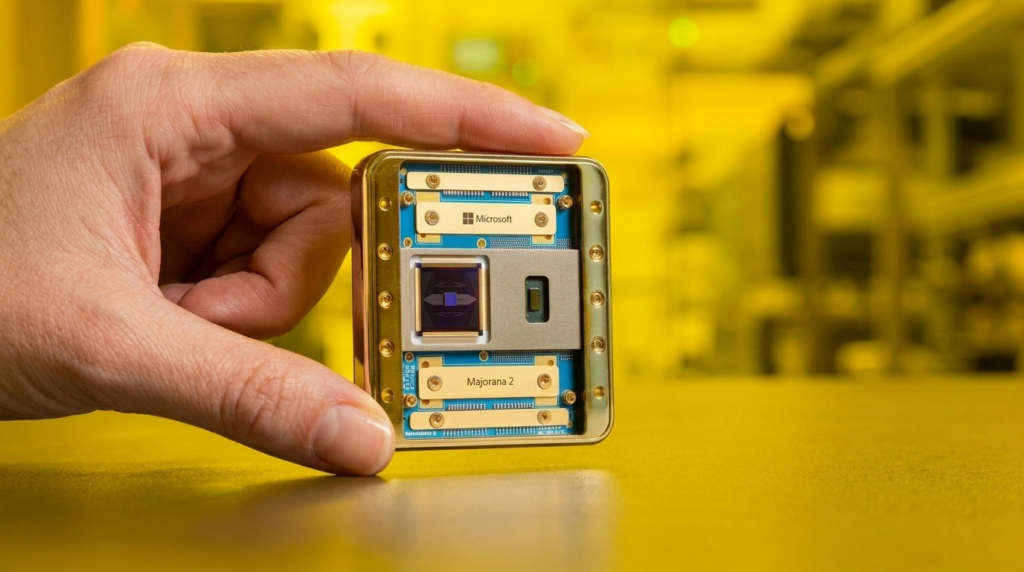
Microsoft has introduced Majorana 2, a next-generation quantum chip that signals a major step in the company’s long-term quantum computing roadmap. But the story is not only about a new chip. It is also about how agentic AI is starting to reshape scientific discovery itself.
According to Microsoft, Majorana 2 was developed with help from Microsoft Discovery, an agentic AI platform designed for advanced research and development. The company says the new chip includes a redesigned materials stack, stronger qubit reliability, and a path toward scalable quantum computing by 2029.
That makes this announcement important for two reasons.
First, it shows progress in Microsoft’s unusual approach to quantum computing: topological qubits. Second, it reveals how AI agents may become essential research partners in complex scientific fields such as materials science, chip design, quantum physics, manufacturing, and experimental validation.
In simple terms, Microsoft Majorana 2 is not just a quantum chip announcement. It is a preview of how the next generation of scientific breakthroughs may be built: human experts working with specialized AI agents.
What Is Microsoft Majorana 2?
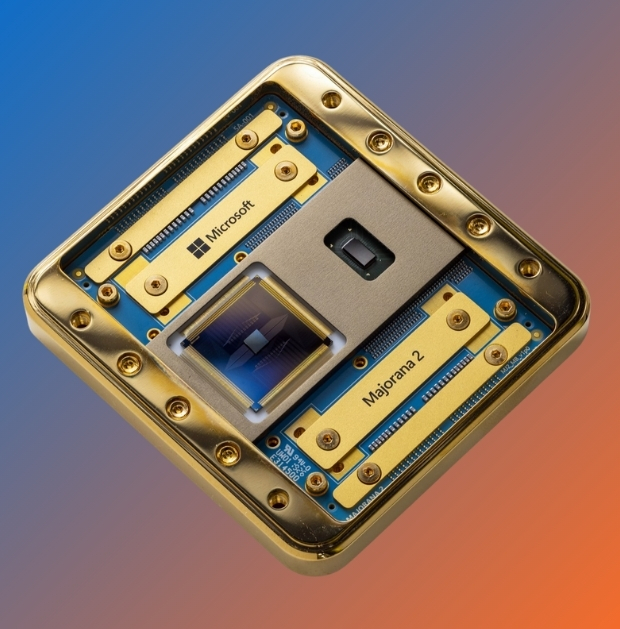
Microsoft Majorana 2 is the company’s newest topological quantum chip. It follows Majorana 1, which Microsoft introduced as part of its push toward building a more stable and scalable quantum computing architecture.
Quantum computers work with qubits, which are the quantum version of classical bits. A normal computer bit is either 0 or 1. A qubit can exist in more complex quantum states, which gives quantum computers the potential to solve certain problems far beyond the reach of classical machines.
The problem is that qubits are extremely fragile.
They can lose their quantum state because of noise, environmental interference, material imperfections, measurement challenges, or tiny disturbances that are almost impossible to control at scale. This is one of the biggest reasons quantum computing has remained difficult to commercialize.
Microsoft’s approach focuses on topological qubits, which are designed to be more naturally protected from certain types of errors. If this approach succeeds, it could make quantum computers more reliable and easier to scale.
Majorana 2 is Microsoft’s latest step in that direction.
Why Majorana 2 Matters
Majorana 2 matters because quantum computing is not waiting for one single breakthrough. It requires progress across many areas at once.
A useful quantum computer needs reliable qubits, fast operations, advanced error correction, scalable manufacturing, strong software systems, precise measurement tools, and a practical architecture. Weakness in one area can slow the entire system.
Microsoft says Majorana 2 brings major improvements in reliability compared with its earlier generation of qubits. The company also says the new chip has a mean qubit lifetime of 20 seconds, with some instances lasting up to one minute.
That is a big claim in the context of quantum computing, where maintaining a stable quantum state is one of the hardest technical problems.
If Microsoft can continue improving this architecture, the long-term impact could be serious. A scalable quantum computer could eventually help solve problems in chemistry, medicine, energy, materials science, climate modeling, food systems, and industrial optimization.
But this is not a finished revolution yet. It is still a roadmap.
The important point is that Microsoft is claiming measurable progress toward making quantum computing more reliable and commercially useful.
The Role of Agentic AI in Majorana 2
The most interesting part of the Majorana 2 announcement is the role of agentic AI.
Agentic AI refers to AI systems that can do more than answer simple prompts. These systems can plan tasks, analyze large amounts of information, generate hypotheses, coordinate workflows, make recommendations, and help automate multi-step research processes.
In Microsoft’s case, the quantum team used Microsoft Discovery to support research workflows around Majorana 2. The AI agents helped manage complex information, analyze experimental data, automate measurements, optimize fabrication, detect flaws, and propose potential solutions.
This matters because quantum research is not simple linear work. It involves physics, materials science, electrical engineering, fabrication, software, measurement systems, and experimental design. Each change can affect multiple other areas.
A human team can manage this, but it is slow and difficult. AI agents can help connect patterns across large datasets, summarize research history, identify hidden relationships, and accelerate experiments.
That does not mean AI replaces scientists. Microsoft describes the process as human-guided. The AI provides support, but scientists remain in the loop.
This may become one of the most important models for future research: AI agents doing the heavy information work while human experts make the critical decisions.
What Is Microsoft Discovery?
Microsoft Discovery is the company’s agentic AI platform for Frontier R&D. It is designed to help researchers use teams of specialized AI agents for scientific and engineering problems.
Instead of using AI only as a chatbot, Microsoft Discovery is built around research workflows. The goal is to help teams reason over knowledge, generate hypotheses, design experiments, validate ideas, and learn from results.
This is especially important in fields where discovery is slow and expensive.
In materials science, for example, researchers may need to test many combinations before finding the right structure or formula. In quantum computing, small imperfections can change the behavior of a device. In drug discovery, chemistry, energy, and manufacturing, experimentation can take years.
Agentic AI can help shorten that cycle by narrowing the search space.
For Majorana 2, Microsoft’s quantum team used AI to help with the kinds of problems that are difficult for humans to handle manually: large datasets, scattered information, complex relationships between variables, and repetitive measurement tasks.
That is the bigger story behind the chip.
Majorana 2 is a quantum computing milestone, but Microsoft Discovery is the system that shows how AI could accelerate many other research fields too.
How Agentic AI Can Speed Scientific Discovery
Scientific discovery usually moves through a cycle:
Researchers study previous knowledge.
They form a hypothesis.
They design experiments.
They collect data.
They analyze results.
They adjust the next experiment.
This process works, but it can be slow. In advanced fields, the amount of data can become too large for any single scientist to fully understand.
Agentic AI can help by speeding up several parts of the cycle.
It can scan large bodies of research and internal data. It can compare results across experiments. It can identify patterns that are easy to miss. It can suggest new experiments. It can automate repeated measurements. It can help detect errors in data collection or equipment behavior.
For quantum computing, this is highly valuable because the work depends on precision.
A small material flaw, a bad sensor reading, or a poorly tuned parameter can distort results. AI agents can help filter noise, organize findings, and guide researchers toward better decisions.
This is why Majorana 2 is not only a hardware story. It is also a workflow story.
The chip improved because the research process around it became smarter.
Why Topological Qubits Are Important
Most quantum computing approaches struggle with error rates. Qubits are sensitive, and quantum information can easily degrade. That is why many companies invest heavily in error correction.
Microsoft’s topological approach tries to reduce the problem at the qubit level. The idea is to create qubits that are more protected by the nature of their physical design.
If topological qubits can be made reliable and scalable, they could reduce some of the overhead needed for quantum error correction. That could make practical quantum computing easier to achieve.
This is why Microsoft has spent years pursuing a different path from many other quantum computing companies.
It is a high-risk, high-reward strategy.
If it fails, Microsoft may lose time compared with competitors using other quantum architectures. But if it succeeds, the company could have a more stable foundation for scalable quantum systems.
Majorana 2 is Microsoft’s attempt to show that this path is producing real progress.
What Could Scalable Quantum Computing Unlock?
A scalable quantum computer could eventually change how we solve certain types of problems.
This does not mean quantum computers will replace normal computers. Classical computers will still be better for everyday tasks such as browsing the web, writing documents, running apps, streaming video, and managing most business systems.
Quantum computers are different. They are designed for certain classes of problems where quantum behavior can provide a major advantage.
Potential areas include:
Drug discovery
Battery chemistry
Advanced materials
Climate modeling
Fertilizer and food systems
Optimization problems
Cryptography research
Energy production
Molecular simulation
The most valuable use cases may come from science and industry, not consumer apps.
That is why Microsoft’s announcement is important for enterprises, researchers, governments, and deep-tech investors. If scalable quantum computing becomes commercially useful, it could become a major infrastructure layer for the next era of scientific and industrial innovation.
Why the 2029 Roadmap Is Important
Microsoft says it now expects to achieve a scalable quantum computer by 2029. That is a bold timeline.
The date matters because quantum computing has often been discussed as a technology that is always “ten years away.” Companies make progress, but practical large-scale quantum machines remain difficult.
By pointing to 2029, Microsoft is giving the market a clearer sense of urgency.
Still, readers should understand this carefully. A roadmap is not the same as a finished product. Quantum computing remains one of the most technically difficult fields in technology. Many things still need to work at scale before quantum systems become commercially valuable.
But Microsoft’s claim shows confidence.
The company is saying that the combination of topological qubits, improved materials, AI-assisted research, and faster experimentation could shorten the path to scalable quantum computing.
That is why Majorana 2 should be watched closely.
Why This Matters for AI
The Majorana 2 announcement also shows how AI is moving beyond content generation.
Many people still think of AI mainly as chatbots, image generators, writing tools, and coding assistants. But Microsoft Discovery points to a deeper use case: AI as a research accelerator.
This is where agentic AI could become extremely powerful.
If AI agents can help scientists discover better materials, optimize experiments, identify hidden flaws, and connect knowledge across disciplines, then AI may become a core tool for innovation itself.
That creates a loop:
AI helps build better quantum systems.
Quantum systems may eventually help solve harder scientific problems.
Those breakthroughs could then support better AI, better materials, and better infrastructure.
It is too early to say exactly how this loop will develop, but the direction is clear. The future of AI may not only be about replacing tasks. It may be about accelerating discovery.
Majorana 2 is one of the clearest examples of that shift.
The Big Picture
Microsoft Majorana 2 sits at the intersection of three major technology trends:
Quantum computing
Agentic AI
Scientific automation
That combination is what makes the announcement strategically important.
Quantum computing aims to unlock new kinds of computation. Agentic AI aims to accelerate complex workflows. Scientific automation aims to make research faster, cheaper, and more precise.
Together, these trends could change how breakthroughs are made.
Instead of researchers relying only on manual experimentation and isolated data, future labs may use AI agents that continuously analyze results, generate hypotheses, and guide experiments. Human scientists would still lead, but they would work with systems that can process knowledge at a scale no individual can match.
That is the real shift behind Majorana 2.
It is not just that Microsoft built a better quantum chip. It is that the process of building the chip is starting to look different.
Final Thoughts
Microsoft Majorana 2 is an important step in the company’s quantum computing strategy. It brings together improved topological qubits, a new materials approach, and the use of Microsoft Discovery’s agentic AI to accelerate scientific progress.
The chip itself matters because reliability is one of the biggest barriers in quantum computing. But the larger lesson may be even more important: AI agents are becoming part of the research process.
If this model works, it could reshape more than quantum computing. It could influence drug discovery, materials science, energy, manufacturing, chemistry, and other fields where progress depends on complex experimentation.
Majorana 2 is still part of a long road. A scalable quantum computer is not here yet. But Microsoft’s announcement suggests that the road may be getting shorter, and that agentic AI could be one of the tools that helps get us there.